Cooling towers are the silent giants of industrial landscapes, often overlooked but absolutely essential. They play a critical role in keeping power plants, refineries, chemical factories, and large HVAC systems from overheating. Among the different types, the cross-flow open cooling tower is one of the most common and fascinating. It’s a marvel of simple physics applied on a massive, industrial scale.
The Cooling Tower’s Core Function
At its heart, a cooling tower’s job is straightforward: to reject waste heat into the atmosphere. Almost every industrial process generates heat, and if this heat isn’t removed, the equipment will fail.
The Principle of Evaporative Cooling
The entire operation of a cooling tower relies on the principle of evaporative cooling. You experience this every day when you sweat. As water evaporates from your skin, it draws a significant amount of heat energy with it, making you feel cooler.
A cooling tower does the same thing. Hot water from an industrial process is sprayed or allowed to cascade inside the tower. As a small fraction of this water evaporates, it cools down the remaining, non-evaporated water. This cooled water is then returned to the industrial equipment to absorb more heat, completing the cycle. The heat that was removed is carried away by the air and released into the atmosphere as water vapor (the visible “steam” you see rising from the tower).
Anatomy of a Cross-flow Design
The term “cross-flow” describes the relationship between the hot water falling through the tower and the air moving through it.
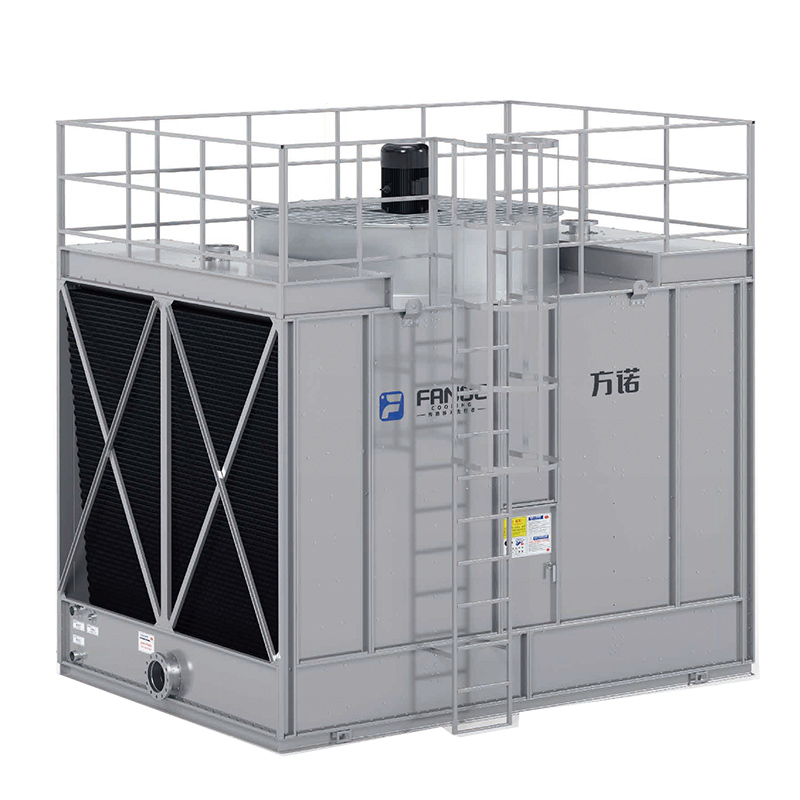
Air and Water in Motion
In a cross-flow design, the air moves horizontally across the path of the water, which is falling vertically. Imagine rain falling, and a strong side-wind blowing through it—that’s the cross-flow concept.
- Water Distribution: Hot water enters the top of the tower and flows into hot water distribution basins. These basins have holes or nozzles that allow the water to trickle down evenly.
- Fill Media: The water falls through fill media (often called “packing”). This is a large, high-surface-area material (like plastic sheets or slats) that breaks the water into thin films or tiny droplets. This dramatically increases the water’s surface area, maximizing its contact with the air for efficient evaporation.
- Air Intake: Air is drawn in through the sides of the tower. Fans, typically located at the top (creating an induced draft), pull the air horizontally across the falling water and the fill.
- Drift Eliminators: Before the air is released, it passes through drift eliminators. These are essential safety devices that capture large water droplets that might otherwise be carried out with the exhaust air. This conserves water and prevents surrounding areas from getting wet.
- Collection Sump: The cooled water collects at the bottom in a cold water basin (or sump) and is pumped back to the facility’s heat exchanger.
Why Choose a Cross-flow Tower?
The cross-flow configuration offers several practical advantages that make it popular in many industries:
- Easy Access and Maintenance: Because the water distribution system is typically on top and outside the main air stream, it’s easier to access for cleaning, repair, or inspection while the tower is running.
- Lower Pumping Head: The hot water can enter the tower at a lower elevation compared to other designs, meaning the pumps don’t have to work as hard, which saves energy.
- Consistent Water Flow: The gravity-fed distribution basin design ensures a more uniform spread of water over the fill media, which contributes to reliable cooling performance.
In essence, the cross-flow open cooling tower is a testament to effective engineering, quietly using one of nature’s most fundamental processes—evaporation—to keep the gears of modern industry running smoothly.



 Eng
Eng English
 中文简体
中文简体

 What Is an Open Circuit Cooling Tower and How Does It Work?
 What Is a Closed Type Cooling Tower and When Should You Use One?How a Closed Type Cooling Tower Actually Works A closed type cooling tower — also widely referred to as a closed-circuit cooling tower, closed-loop c...
 Cooling Tower Guide: Types, How They Work & Selection CriteriaHow a Cooling Tower Actually Works A cooling tower is a heat rejection device that removes waste heat from a process or building system by transferrin...
 Industrial Cooling Towers: How They Work, Types, and How to Keep Them Running RightWhat Industrial Cooling Towers Do and Why They Matter Industrial cooling towers are large heat rejection systems designed to remove excess thermal en...
 Evaporative Condenser Explained: How It Works, How to Choose One, and How to Keep It RunningWhat Is an Evaporative Condenser and How Does It Work? An evaporative condenser is a heat rejection device that combines the functions of a condenser ...