An open circuit cooling tower is one of the most common and cost-effective solutions for industrial and commercial heat rejection. If you're evaluating cooling options for a facility, or simply trying to understand how your existing system works, this guide walks you through everything that matters — from the basic operating principle to maintenance best practices and buying considerations.
How an Open Circuit Cooling Tower Works
In an open circuit cooling tower, the process water being cooled comes into direct contact with the ambient air. Warm water from the system is pumped to the top of the tower and distributed over a fill media, which breaks the water into thin sheets or droplets to maximize surface area. As air flows through the tower — either naturally or via a fan — a small portion of the water evaporates. This evaporation pulls heat out of the remaining water, which then returns to the system at a lower temperature.
This direct contact between water and air is what defines an open circuit design. It is highly efficient at heat rejection because evaporative cooling is far more effective than dry heat exchange. However, because the water is exposed to outside air, it picks up dust, debris, and biological contaminants over time — which is why proper maintenance is essential.
Types of Open Circuit Cooling Towers
Open circuit cooling towers come in several configurations, each suited to different site conditions, airflow requirements, and capacity needs. Understanding the differences helps you match the right tower to your application.
Counterflow vs. Crossflow
These two terms describe the relationship between the direction of the falling water and the direction of the airflow:
- Counterflow: Air moves upward through the fill while water falls downward. The two flows run in opposite directions, which allows for more efficient heat transfer in a smaller footprint. Counterflow towers tend to be taller and more compact horizontally.
- Crossflow: Air moves horizontally through the fill as water falls vertically. This design is generally easier to access for maintenance and better suited to applications where height clearance is limited. Crossflow towers have a wider, lower profile.
Induced Draft vs. Forced Draft
This distinction refers to where the fan is positioned in the airflow path:
- Induced draft: The fan sits at the top of the tower and pulls air upward through the fill. This is the more common configuration and produces a more uniform airflow with less risk of hot, humid exhaust air being recirculated back into the intake.
- Forced draft: The fan sits at the base and pushes air up through the fill. These towers are easier to access for fan maintenance, but they are more prone to recirculation issues in certain site layouts.
Natural Draft Towers
Large hyperboloid natural draft towers — the type commonly seen at power plants — use the temperature difference between inside and outside air to create airflow without a mechanical fan. These are typically only practical at very large scale and are not commonly specified for commercial or mid-sized industrial applications.
Open Circuit vs. Closed Circuit Cooling Tower: Key Differences
A common point of confusion is the difference between open circuit and closed circuit (fluid cooler) designs. The table below summarizes the main distinctions:
| Feature |
Open Circuit Cooling Tower |
Closed Circuit Cooling Tower |
| Water-air contact |
Direct |
Indirect (coil separates process fluid) |
| Cooling efficiency |
Higher |
Slightly lower |
| Contamination risk |
Higher (process water exposed) |
Lower (process fluid stays closed) |
| Maintenance demand |
Higher |
Lower |
| Capital cost |
Lower |
Higher |
| Best suited for |
High heat loads, cost-sensitive projects |
Sensitive processes, clean fluid requirements |
For most general industrial and HVAC applications where the process water does not need to stay completely isolated from atmospheric exposure, an open circuit cooling tower offers better value per ton of heat rejection.
Main Advantages of Open Circuit Cooling Towers
Open circuit cooling towers remain the dominant choice across industries for several practical reasons:
- High thermal efficiency: Evaporative cooling can reject heat down to near the wet-bulb temperature of the ambient air, which is significantly lower than what dry coolers can achieve. This makes open circuit towers highly effective in warm climates or high heat-load applications.
- Lower upfront cost: Without the heat exchanger coil required in closed circuit designs, open circuit towers cost less to manufacture and install at equivalent capacity.
- Scalability: Modular open circuit cooling tower configurations allow capacity to be added incrementally by adding cells, making them practical for expanding facilities.
- Proven technology: The operating principle is well understood, parts are widely available, and qualified service technicians are easy to find in most markets.
- Wide application range: Open circuit cooling towers are used across power generation, manufacturing, steel production, chemical processing, data centers, and commercial HVAC — few industries don't have a use for them.
Common Applications
Open circuit cooling towers are found in a broad range of industries. Some of the most common use cases include:
- HVAC systems: Large commercial buildings, hospitals, hotels, and universities use open circuit towers to reject heat from chiller systems. The tower sits outdoors on the roof or at grade, connected to the chiller's condenser loop.
- Industrial process cooling: Manufacturing plants use cooling towers to remove heat from injection molding machines, hydraulic systems, compressors, and heat exchangers. Stable process temperatures directly affect product quality and equipment lifespan.
- Power generation: Thermal and nuclear power plants rely heavily on open circuit cooling towers to condense steam after it passes through turbines. These are typically large multi-cell installations.
- Data centers: As computing density increases, data centers are increasingly turning to evaporative cooling strategies, including open circuit tower integration, to manage heat rejection economically.
- Food and beverage processing: Cooling is required at multiple stages of food production — from fermentation temperature control to equipment cooling — and open circuit towers are a standard tool in these facilities.
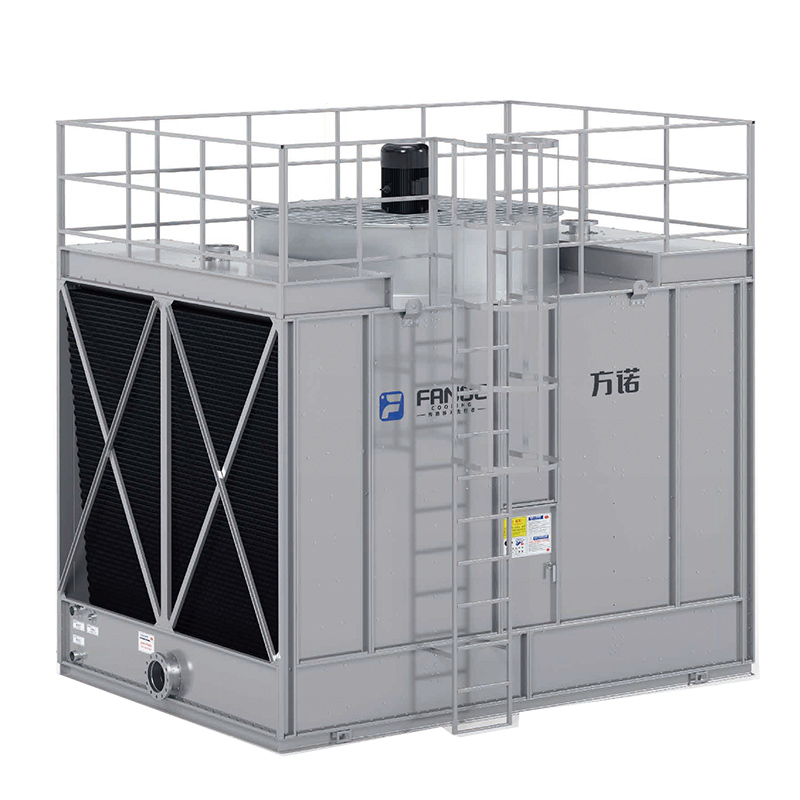
Key Components and What They Do
Understanding the main components of an open circuit cooling tower helps with both troubleshooting and specification:
- Fill media: The structured or splash packing material over which water is distributed. It maximizes surface area for water-air contact. Fill can be film-type (thin corrugated sheets) or splash-type (bars that break water into droplets). Film fill is more efficient but more prone to fouling in poor water quality conditions.
- Distribution system: Spray nozzles or perforated pipes that distribute warm water evenly over the fill. Uneven distribution leads to hot spots and reduced efficiency.
- Drift eliminators: Baffled sections above the fill that capture water droplets carried by the airflow, preventing them from leaving the tower as drift. Drift loss carries dissolved minerals and biological material, so effective eliminators matter both for water conservation and for Legionella risk management.
- Cold water basin: The reservoir at the base of the tower that collects cooled water before it's pumped back to the system. Basin hygiene is critical — stagnant water with sediment is a prime breeding ground for bacteria.
- Fan and motor assembly: Drives the airflow through the tower. Fan blade pitch, motor efficiency, and variable frequency drives (VFDs) all affect energy consumption significantly.
- Makeup water connection: Replenishes water lost to evaporation, drift, and blowdown. A float valve or automated control system maintains basin water level.
Maintenance Requirements You Shouldn't Overlook
Because open circuit cooling towers expose process water directly to outside air, water quality management and mechanical upkeep are non-negotiable. Skipping routine maintenance leads to scale buildup, biofouling, corrosion, and — critically — Legionella risk.
Water Treatment
As water evaporates, dissolved minerals concentrate in the basin. Without treatment, this leads to scale on fill and heat exchangers. A proper water treatment program typically includes:
- Regular blowdown (controlled discharge of concentrated water) to manage total dissolved solids (TDS)
- Scale and corrosion inhibitors dosed according to water chemistry
- Biocides (typically chlorine, bromine, or non-oxidizing biocides) to control microbial growth
- pH monitoring and adjustment to keep water within a non-corrosive, non-scaling range (typically 6.5–8.5)
Mechanical Inspection
Mechanical components should be inspected on a regular schedule. Key checks include:
- Fan blade condition, pitch angle, and balance — imbalanced blades cause vibration and accelerate bearing wear
- Motor lubrication and electrical connections
- Gearbox oil level and condition (for gear-driven towers)
- Fill media condition — cracked, collapsed, or fouled fill needs replacement
- Drift eliminator integrity — damaged eliminators increase water loss and biological risk
- Basin cleaning to remove sediment, sludge, and biofilm buildup
Legionella Risk Management
Open circuit cooling towers are a recognized risk environment for Legionella pneumophila, the bacterium that causes Legionnaires' disease. Warm, stagnant water with nutrients from organic debris creates ideal growth conditions. Most jurisdictions now require a formal Legionella risk assessment and a documented Water Safety Plan for cooling towers. Key controls include maintaining effective biocide levels, minimizing drift, avoiding dead legs in pipework, and conducting thorough cleaning and disinfection at startup, shutdown, and at least annually during operation.
What to Consider When Selecting an Open Circuit Cooling Tower
Choosing the right open circuit cooling tower for a project involves more than just matching the heat load. Several factors affect long-term performance, cost, and operability:
- Design wet-bulb temperature: Tower capacity is rated at a specific ambient wet-bulb temperature. Make sure the design condition matches the local climate, not a generic standard — undersizing based on incorrect climate data is a common mistake.
- Range and approach: Range is the temperature drop across the tower (inlet water temp minus outlet water temp). Approach is the difference between the outlet water temperature and the wet-bulb temperature. A smaller approach requires a larger, more expensive tower. Know your system's required leaving water temperature before specifying.
- Water quality: Poor source water quality (high hardness, high TDS, biological load) affects fill selection, treatment costs, and maintenance frequency. In areas with hard water, splash fill may outperform film fill despite lower efficiency.
- Site constraints: Available footprint, prevailing wind direction, proximity to air intakes or occupied spaces (for noise and drift management), and structural loading capacity all influence tower selection and placement.
- Energy efficiency: Fan motor efficiency and the availability of variable frequency drives (VFDs) significantly affect operating costs over the tower's life. VFDs allow fan speed to be reduced during mild weather, cutting energy use substantially.
- Material selection: Tower structure can be fiberglass, galvanized steel, stainless steel, or concrete depending on the application and budget. Corrosive environments or aggressive water chemistry may require upgraded materials.
Typical Performance Metrics to Know
When reviewing specifications or comparing suppliers, the following metrics are the ones that matter most for an open circuit cooling tower:
| Metric |
What It Means |
Typical Range |
| Cooling capacity |
Heat rejected, expressed in tons or kW |
10 tons to 10,000+ tons |
| Range |
Hot water in temp minus cold water out temp |
5°F – 15°F (3°C – 8°C) typical |
| Approach |
Cold water out temp minus wet-bulb temp |
5°F – 10°F (3°C – 6°C) typical |
| Evaporation rate |
Water lost to evaporation as % of flow rate |
~1% per 10°F (5.6°C) of range |
| Drift loss |
Water carried out as droplets in exhaust air |
0.001% – 0.005% of flow (modern eliminators) |
| Cycles of concentration |
Ratio of TDS in circulating water vs makeup water |
3–7 cycles typical |
Final Thoughts
An open circuit cooling tower is a proven, cost-effective technology for heat rejection across a wide range of industries and applications. Its core advantage — using evaporation to cool water directly — delivers thermal performance that dry cooling systems simply can't match at comparable cost. The trade-off is a higher maintenance burden and the need for active water treatment, but for most applications these are manageable with a proper program in place.
Whether you're specifying a new open circuit cooling tower for a project, troubleshooting an existing installation, or evaluating suppliers, the fundamentals covered here — tower type, key components, performance metrics, and maintenance requirements — give you a solid foundation to make informed decisions and avoid the most common pitfalls.



 Eng
Eng English
 中文简体
中文简体

 What Is an Open Circuit Cooling Tower and How Does It Work?
 What Is a Closed Type Cooling Tower and When Should You Use One?How a Closed Type Cooling Tower Actually Works A closed type cooling tower — also widely referred to as a closed-circuit cooling tower, closed-loop c...
 Cooling Tower Guide: Types, How They Work & Selection CriteriaHow a Cooling Tower Actually Works A cooling tower is a heat rejection device that removes waste heat from a process or building system by transferrin...
 Industrial Cooling Towers: How They Work, Types, and How to Keep Them Running RightWhat Industrial Cooling Towers Do and Why They Matter Industrial cooling towers are large heat rejection systems designed to remove excess thermal en...
 Evaporative Condenser Explained: How It Works, How to Choose One, and How to Keep It RunningWhat Is an Evaporative Condenser and How Does It Work? An evaporative condenser is a heat rejection device that combines the functions of a condenser ...