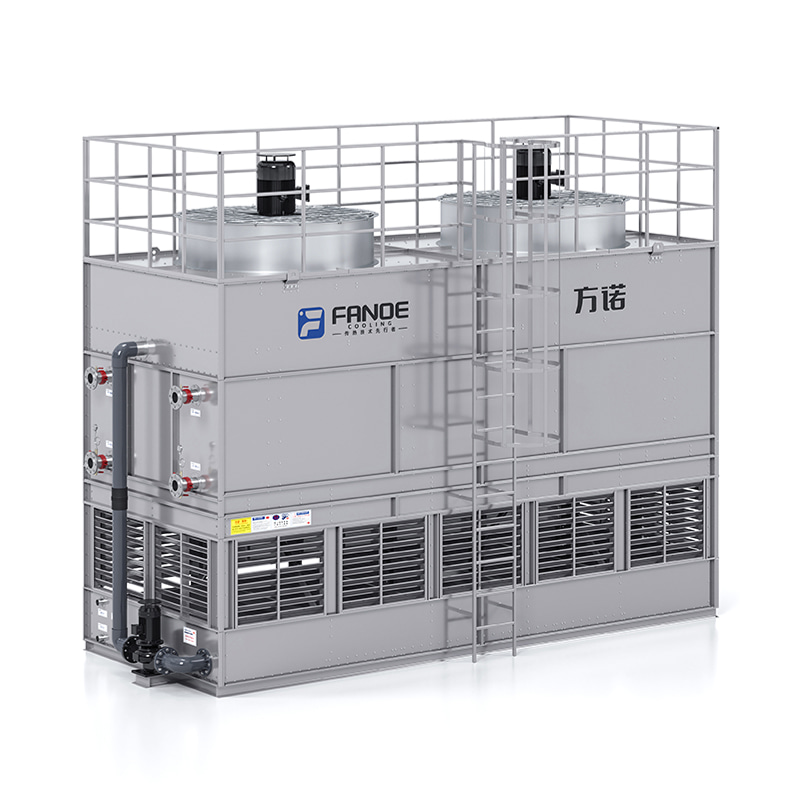
Closed cooling towers use the principle of absorbing heat during water evaporation to cool the liquid. Spray water (cooling water) is stored at the bottom of the cooling tower, and the working fluid (softened water or other liquid) circulates in a closed loop in the heat dissipation coil of the closed cooling tower. The spray water is pumped by the spray system through the water distribution system and spray nozzles and sprayed on the surface of the coil. Part of the water evaporates, absorbs heat, and thus lowers the temperature of the working fluid inside the tube.
The water in the hot air and the unevaporated water are intercepted by a water blocking plate and flow through the PVC heat exchange layer. The water in the PVC heat exchange layer is cooled by the flowing air, the temperature decreases, and falls into the bottom water tray. It is then recycled by the water pump to the water distribution system and returned to the sprinkler pipe for circulating cooling.
The function of a closed cooling tower
A closed cooling tower exchanges heat between cooling water carrying heat and air inside the tower, transferring the heat to the air and dissipating it into the atmosphere. One of the heat exchange methods between water and air in a cooling tower is that the air flowing over the surface of the water comes into direct contact with the water, and the heat in the water is transferred to the air through contact heat transfer and evaporation heat dissipation. This method of cooling is called a wet cooling tower. The heat transfer efficiency of wet cooling towers is high, and the max/ temperature at which water is cooled is the wet bulb temperature of the air. However, water is lost due to evaporation; Evaporation increases the salinity of the circulating cooling water, and in order to stabilize the water quality, it is necessary to discharge a portion of the water with higher salinity. Wind can also cause water loss due to drifting. Sufficient new water must be continuously replenished. Therefore, wet cooling towers require a water source to supply water.
In water-scarce areas where it is difficult to replenish water, dry cooling towers can only be used. The heat exchange between air and water in a dry cooling tower is achieved through the surface heat transfer of a radiator composed of metal tubes, which transfers the heat inside the tubes to the air flowing outside the radiator. The heat transfer efficiency of dry cooling towers is lower than that of wet cooling towers, and the max. cooling temperature is the dry bulb temperature of the air. These devices require a large one-time investment and the energy consumption of the fans is high.
Application scope of closed cooling tower:
We are a professional enterprise engaged in the research and development and production of cooling equipment. It mainly produces counterflow cooling towers, cross-flow cooling towers, composite flow closed cooling towers, and steel cooling tower evaporative condensers. This product is widely used in aerospace, electronics, instruments, textiles, refrigeration units, constant temperature and humidity, casting, forging, quenching liquids, melting furnaces, crystallizers, continuous casting machines, rolling mills, heating furnaces, electric arc furnaces, central air conditioning, heat pumps, air compressors, hydraulic oil, injection molding machine cooling and other fields. In addition, as a production base for many foreign-funded large-scale cooling tower companies, the company also has a complete technology and production system in the field of cooling towers. The specific division is as follows:
A, Air temperature regulation: air conditioning equipment, cold storage, refrigeration room, freezing, heating and cooling air conditioning, etc.
B, Manufacturing and processing industries: food industry, pharmaceutical industry, metal casting, plastic industry, rubber industry, textile industry, steel plant, chemical industry, petrochemical products, etc.
C, Mechanical operation cooling category: generators, steam turbines, air compressors, hydraulic presses, engines, etc.
D, Other industries.



 Eng
Eng English
 中文简体
中文简体

 What Is an Open Circuit Cooling Tower and How Does It Work?
 What Is a Closed Type Cooling Tower and When Should You Use One?How a Closed Type Cooling Tower Actually Works A closed type cooling tower — also widely referred to as a closed-circuit cooling tower, closed-loop c...
 Cooling Tower Guide: Types, How They Work & Selection CriteriaHow a Cooling Tower Actually Works A cooling tower is a heat rejection device that removes waste heat from a process or building system by transferrin...
 Industrial Cooling Towers: How They Work, Types, and How to Keep Them Running RightWhat Industrial Cooling Towers Do and Why They Matter Industrial cooling towers are large heat rejection systems designed to remove excess thermal en...
 Evaporative Condenser Explained: How It Works, How to Choose One, and How to Keep It RunningWhat Is an Evaporative Condenser and How Does It Work? An evaporative condenser is a heat rejection device that combines the functions of a condenser ...